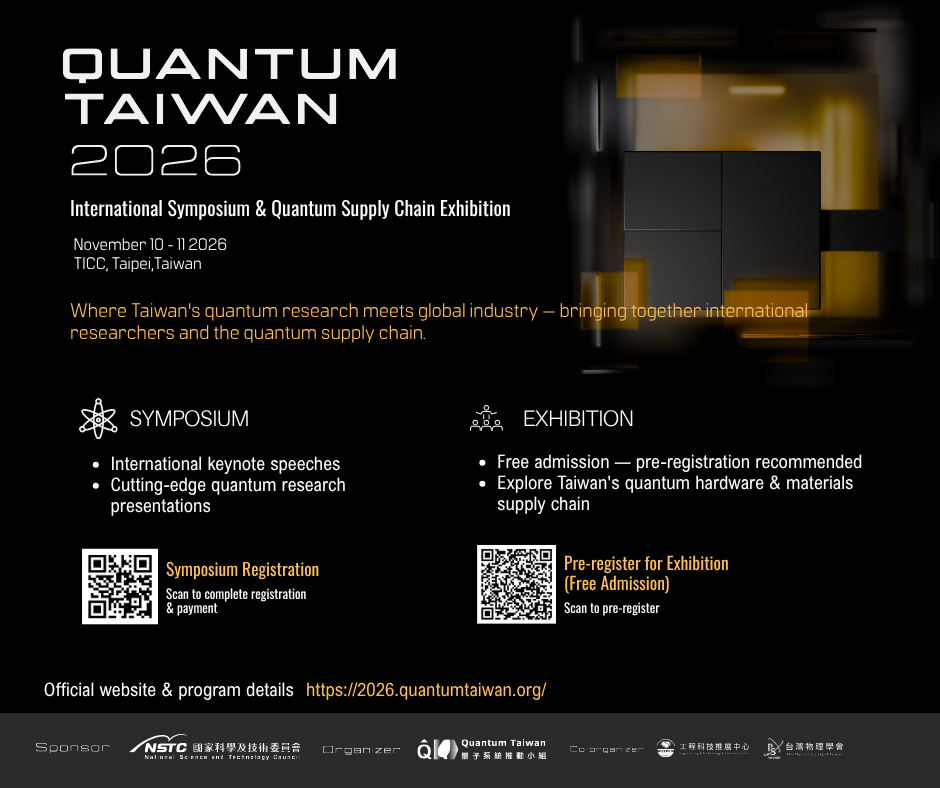
Quantum Taiwan 2026 正式開放報名。
活動將於 11 月 10 日至 11 日在台北國際會議中心(TICC)舉行, 同時涵蓋國際研討會與量子供應鏈展兩大部分。 國際研討會匯集國內外量子領域學者專題演講,發表前沿研究成果,採付費報名制,名額有限。
活動資訊 / 2026-09-15

2026年會壁報論文獎得獎名單
★優勝 得獎人 學校單位 發表編號 陳子曦 (Tsz Hei Chan) 國立清華大學 P1-AG-005 楊孟哲 (Meng-Zhe Yang) 國立清華大學 P1-AG-027 柯奕恩 (Mhar Ian Estayan) 國立東華大學 P2-AI-004 李哲維 (Che-Wei Lee) 國立臺灣大學 P2-AM-008 Masaya Taniguchi 奈良先端科學技術大學院大學(JP) P1-BPI-002 陳彥憲 (Yan-Hsien Chen) 中央研究院 P1-BPI-028 張億宏 (Yi-Hong Chang) 淡江大學 P2-EES-006 楊佩瑩 (Pei-Ying Yang) 國立中山大學 P2-MSP-039 唐萬昇 (Wan-Sheng Tang) 國立中央大學 P2-MSP-044 何俊明 (Jun-Ming He) 國立陽明交通大學 P1-OP-007 黃凌琦 (Ling-Qi Huang) 國立陽明交通大學 P1-OP-060 黃浩鑫 (Hao-Hsin Huang) 國立陽明交通大學 P1-OP-071 沈品甄 (Ping Chen Shen) 國立臺灣大學 P1-OP-093 周禹璇 (Yu-Hsuan Chou) 國立中央大學 P2-PF-010 劉子頎 (Tzu-Chi Liu) 國立成功大學 P2-PP-001 蔡立勛 (Li-Xun Cai) 國立成功大學 P2-QI-001 吳宣誼 (Hsuan-I Wu) 國立成功大學 P2-SC-012 鄭博元 (Po-Yuan Cheng) 國立成功大學 P2-SC-048 洪晟耀 (Sheng-Yao Hung) 國立成功大學 P2-SL-027 陳叡柏 (JUI-PO CHEN) 國立臺灣師範大學 P2-SL-033 黃居易 (Ju-Yi Huang) 國立臺灣師範大學 P2-SL-043 馮信堯 (Hsin-Yao Feng) 中央研究院 P1-SM-002 陳又維 (Yu-Wei Chen) 國立陽明交通大學 P1-SOE-002 李岱庭 (Tai-Ting Lee) 國立臺灣大學 P1-SOE-005 陳怡杏 (Yi-Sing Chen) 國立成功大學 P1-SOE-043 曾懷恩 (Huai-En Tseng) 國立陽明交通大學 P1-SOE-056 彭宇宏 (Yu Hung Peng) 國立臺灣科技大學 P1-SOE-095
台灣物理年會壁報論文獎 / 2026-09-09
2025年會壁報論文獎得獎名單
★優勝 得獎人 學校單位 發表編號 楊婷凱 (Ting-Kai Yang) 國立臺灣大學 P1-AG-053 李奕德 (Yi-De Lee) 國立成功大學 P1-AG-069 吳語萱 (Yu-Xuan Wu) 中央研究院 P1-AM-006 張丞佑 (Cheng Yu Chang) 國立東華大學 P2-BPI-024 黃至揚 (Chih-Yang Huang) 國立臺灣大學 P1-EES-017 吳心蕙 (Xin-Hui Wu) 國立彰化師範大學 P2-MSP-003 劉恩沛 (En Pei Liu) 國立臺灣大學 P2-MSP-022 張珉嘉 (Min-Jia Zhang) 國立臺灣師範大學 P2-OP-036 張時造 (Shi-Zao Chang) 國立陽明交通大學 P2-OP-054 江明寯 (Ming-Chun Jiang) 國立臺灣大學 P2-OP-061 陳品毅 (Chen Pin-I) 國立中央大學 P1-PF-010 趙翊丞 (Yi-Cheng Zhao) 國立中央大學 P1-PP-012 杜小田 (Dexter To) 菲律賓大學(PH) P2-PT-003 嚴暐傑 (Wei Jie Yan) 國立清華大學 P1-QI-029 許吉松 (Ji-Song Hsu) 國立臺灣大學 P1-SC-004 陳柏年 (Bo-Nian Chen) 國立成功大學 P1-SL-019 洪琳喬 (Lin-Chiao Hung) 國立中央大學 P2-SM-002 嚴孟城 (Meng-Cheng Yen) 國立臺灣大學 P2-SOE-033 顏婕如 (Jie-Ru Yen) 國立陽明交通大學 P2-SOE-044 蔡語媗 (Yu Hsuan Tsai) 國立清華大學 P2-SOE-094 艾飛宇 (Aitor Garcia-Ruiz) 國立成功大學 P2-SOE-102
台灣物理年會壁報論文獎 / 2026-09-09
2024年會壁報論文獎得獎名單
★優勝 得獎人 學校單位 發表編號 陳昕霈 (Hsin-Pei Chen) 國立清華大學 P2-AG-020 黃尼哥 (Aloysius Niko) 國立中央大學 P2-AG-071 李奕德 (Yi-De Lee) 國立成功大學 P2-AG-073 陳聿邦 (Yu-Pon Chen) 國立清華大學 P2-AI-004 許濬璿 (Jiun-Shiuan Shiu) 國立成功大學 P1-AM-008 廖婉淇 (WAN-CHI LIAO) 中國醫藥大學 P2-BPI-027 謝氏翠娥 (Nga Ta Thi Thuy) 國立陽明交通大學 P2-EES-009 黃岱陞 (Tai-Sheng Huang) 國立中央大學 P2-MSP-024 陳柏維 (Po-Wei Chen) 國立臺灣師範大學 P2-MSP-025 張馨云 (Xin-Yun Chang) 國立陽明交通大學 P1-OP-012 蕭雅馨 (Ya-Hsin Hsiao) 國立成功大學 P1-OP-026 林佳嫻 (Chia-Hsien Lin) 國立陽明交通大學 P1-OP-043 周禹璇 (Yu-Hsuan Chou) 國立中央大學 P1-PF-007 潘奕佐 (Yi-Zuo Pan) 國立成功大學 P2-PP-015 丁建鈞 (Chien-Chun Ting) 國立清華大學 P1-QI-022 時丕儒 (Pi-Ju Shih) 國立臺灣大學 P1-SC-022 張人驊 (Jen-Hua Chang) 國立清華大學 P2-SL-066 魏士程 (Shih-Cheng Wei) 國立成功大學 P2-SL-069 邱彥承 (Yen Cheng Chiu) 國立陽明交通大學 P2-SL-078 施俊臣 (Jyun-Chen Shih) 國立中正大學 P1-SM-009 銳萬 (Redhwan Moqbel) 國立臺灣大學 P1-SOE-009 陳博義 (Bo-Yi Chen) 國立臺灣大學 P1-SOE-026 李岱庭 (Tai Ting Lee) 國立臺灣大學 P1-SOE-075 周冠儒 (Kuan Ju Zhou) 國立中山大學 P1-SOE-084 巴登杜 (Bhartendu Papnai) 國立清華大學 P1-SOE-092
台灣物理年會壁報論文獎 / 2026-09-09
2026年會口頭發表論文獎得獎名單
得獎人 學校 發表編號 簡子翔 (Zih-Siang Jian) 國立陽明交通大學 A4-OAS-006 詹子明 (Tzu-Ming Chan) 國立清華大學 B4-OAS-003 林育同 (Yu-Tung Lin) 國立清華大學 C4-OAS-003 吳安基 (An-Chi Wu) 中央研究院 D4-OAS-004 蔡和家 (Ho-Chia Tsai) 國立臺灣大學 E4-OAS-002 蘇奕蓁 (Yi-Jhen Su) 中央研究院 F4-OAS-005 邱雁 (Yen Chiu) 國立中央大學 G4-OAS-005 張昕 (Hsin Chang) 國立中央大學 H4-OAS-001 卡蘭 (Karan Savio Arthur Fernandes) 國立臺灣師範大學 I4-OAS-004 卜天心 (Rajashree Bhuyan) 國立臺灣大學 J4-OAS-001 劉子謙 (Zih-Cian Liou) 國立清華大學 K4-OAS-002 朱凱翊 (Kai-I Chu) 國立中央大學 L4-OAS-005 佟尼 (Donnie Remirata Moradas) 中央研究院 M4-OAS-001
口頭發表論文獎 / 2026-09-09
2025年會口頭發表論文獎得獎名單
得獎人 學校 發表編號 陳皓郁 (Hao-Yu Chen) 國立臺灣大學 A4-OAS-003 郭慈豪 (Tzu-Hao Kuo) 國立臺灣師範大學 B4-OAS-005 林俊逸 (Chun-Yi Lin) 國立臺灣大學 C4-OAS-003 江明寯 (Ming-Chun Jiang) 國立臺灣大學 D4-OAS-002 李政諭 (JHENG-YU LEE) 國立中央大學 E4-OAS-006 張允瑄 (Yun-Xuan Zhang) 國立中央大學 F4-OAS-004 曾湘芸 (Hsiang-Yun Tseng) 國立清華大學 G4-OAS-001 李承霖 (Cheng-Lin Lee) 國立臺灣大學 H4-OAS-006 周禹璇 (Yu-Hsuan Chou) 國立中央大學 I4-OAS-004 林雋恒 (Jyun-Heng Lin) 國立臺灣師範大學 J4-OAS-006 羅偉碩 (Wei-Shuo Lo) 國立中央大學 K4-OAS-005 鄧善友 (Shan-You Teng) 國立中央大學 L4-OAS-003 莫哈桑 (Muhammad Hasan) 中央研究院 M4-OAS-002 施緹亞 (Septia Kholimatussadiah) 國立臺灣大學 N4-OAS-001
口頭發表論文獎 / 2026-09-09
2024年會口頭發表論文獎得獎名單
得獎人 學校 發表編號 何勝竹 國立成功大學 A4-OAS-004 王詠鈞 國立清華大學 B4-OAS-002 黃宇豪 國立臺灣大學 C4-OAS-001 姚岳廷 國立成功大學 D4-OAS-002 劉艾音 國立臺灣大學 E4-OAS-002 Rajakar Selvam 國立東華大學 F4-OAS-003 王靖淳 國立陽明交通大學 G4-OAS-001 朱凱翊 國立中央大學 H4-OAS-001 邵暐翔 國立臺灣大學 I4-OAS-004 林彥興 國立清華大學 J4-OAS-002 劉立中 國立臺灣大學 K4-OAS-003 林子翔 國立清華大學 L4-OAS-003 吳祁恩 國立中山大學 M4-OAS-001
口頭發表論文獎 / 2026-09-09

【中研院物理所通識演講訊息】張泰榕特聘教授 (榮獲 2025 年國科會傑出研究獎)
【中研院物理所通識演講訊息】張泰榕特聘教授 (榮獲 2025 年國科會傑出研究獎)
中研院物理所特別邀請國立成功大學物理系張泰榕特聘教授(榮獲 2025 年國科會傑出研究獎)蒞臨演講。張教授專精於拓撲材料電子結構與第一性原理計算,本次演講將深入介紹拓撲能帶理論,並分享磁性與非磁性拓撲絕緣體及軌道拓撲(Orbital Topology)的最新前沿研究。誠摯邀請您一同參與! 【講座資訊】 講者:張泰榕 特聘教授(國立成功大學物理系) 演講題目:Electronic Structure of Topological Materials 時間:2026 年 9 月 8 日(二)14:00 地點:中央研究院物理研究所 1 樓演講廳 接待人:徐晨軒 助研究員 演講語言:英文 活動網頁:https://www.phys.sinica.edu.tw/lecture detail.php?id=3243&eng=T 【演講摘要】 Phase transitions are traditionally understood within Landau's framework of spontaneous symmetry breaking. The discovery of topological phases, however, has established a new paradigm in which quantum states are classified by the topology of their electronic wave functions. In this colloquium, I will introduce the basic concepts of topological band theory and discuss how first-principles calculations have guided the discovery of nonmagnetic and magnetic topological insulators. If time permits, I will conclude by presenting our recent work on orbital topology, highlighting a new topological perspective on the orbital Hall effect. 誠摯邀請您一同參與! 中央研究院物理研究所 敬邀 We are pleased to invite Prof. Tay-Rong Chang from National Cheng Kung University to speak at the upcoming IOP Colloquium. Prof. Chang specializes in the electronic structure of topological materials and first-principles calculations and is a recipient of the 2025 NSTC Outstanding Research Award. In this talk, he will introduce topological band theory and share recent research on topological insulators and orbital topology. 【Event Information】 Speaker: Prof. Tay-Rong Chang / Department of Physics, National Cheng Kung University Title: Electronic Structure of Topological Materials Date & Time: September 08, 2026 (Tue.) 14:00 Venue: 1F Auditorium, Institute of Physics, Academia Sinica Host: Dr. Chen-Hsuan Hsu Language: English Link: https://www.phys.sinica.edu.tw/lecture detail.php?id=3243&eng=T 【Abstract】 Phase transitions are traditionally understood within Landau's framework of spontaneous symmetry breaking. The discovery of topological phases, however, has established a new paradigm in which quantum states are classified by the topology of their electronic wave functions. In this colloquium, I will introduce the basic concepts of topological band theory and discuss how first-principles calculations have guided the discovery of nonmagnetic and magnetic topological insulators. If time permits, I will conclude by presenting our recent work on orbital topology, highlighting a new topological perspective on the orbital Hall effect. We warmly invite you to join us!
中研院物理所特別邀請國立成功大學物理系張泰榕特聘教授(榮獲 2025 年國科會傑出研究獎)蒞臨演講。張教授專精於拓撲材料電子結構與第一性原理計算,本次演講將深入介紹拓撲能帶理論,並分享磁性與非磁性拓撲絕緣體及軌道拓撲(Orbital Topology)的最新前沿研究。誠摯邀請您一同參與! 【講座資訊】 講者:張泰榕 特聘教授(國立成功大學物理系) 演講題目:Electronic Structure of Topological Materials 時間:2026 年 9 月 8 日(二)14:00 地點:中央研究院物理研究所 1 樓演講廳 接待人:徐晨軒 助研究員 演講語言:英文 活動網頁:https://www.phys.sinica.edu.tw/lecture detail.php?id=3243&eng=T 【演講摘要】 Phase transitions are traditionally understood within Landau's framework of spontaneous symmetry breaking. The discovery of topological phases, however, has established a new paradigm in which quantum states are classified by the topology of their electronic wave functions. In this colloquium, I will introduce the basic concepts of topological band theory and discuss how first-principles calculations have guided the discovery of nonmagnetic and magnetic topological insulators. If time permits, I will conclude by presenting our recent work on orbital topology, highlighting a new topological perspective on the orbital Hall effect. 誠摯邀請您一同參與! 中央研究院物理研究所 敬邀 We are pleased to invite Prof. Tay-Rong Chang from National Cheng Kung University to speak at the upcoming IOP Colloquium. Prof. Chang specializes in the electronic structure of topological materials and first-principles calculations and is a recipient of the 2025 NSTC Outstanding Research Award. In this talk, he will introduce topological band theory and share recent research on topological insulators and orbital topology. 【Event Information】 Speaker: Prof. Tay-Rong Chang / Department of Physics, National Cheng Kung University Title: Electronic Structure of Topological Materials Date & Time: September 08, 2026 (Tue.) 14:00 Venue: 1F Auditorium, Institute of Physics, Academia Sinica Host: Dr. Chen-Hsuan Hsu Language: English Link: https://www.phys.sinica.edu.tw/lecture detail.php?id=3243&eng=T 【Abstract】 Phase transitions are traditionally understood within Landau's framework of spontaneous symmetry breaking. The discovery of topological phases, however, has established a new paradigm in which quantum states are classified by the topology of their electronic wave functions. In this colloquium, I will introduce the basic concepts of topological band theory and discuss how first-principles calculations have guided the discovery of nonmagnetic and magnetic topological insulators. If time permits, I will conclude by presenting our recent work on orbital topology, highlighting a new topological perspective on the orbital Hall effect. We warmly invite you to join us!
活動資訊 / 2026-08-27

第六屆學生分會執行委員會
第六屆學生分會會長/副會長/秘書長當選名單公告 會長 郭桓亦 國立臺灣大學物理學系碩士生 副會長 白宴丞 國立中山大學物理學系博士生 祕書長 劉鎮瑜 國立臺灣大學物理學系碩士生 美宣長 徐紹元 國立陽明交通大學電子物理學系大學生 財務長 何明璟 國立臺灣大學物理學系碩士生 委員 吳楷銘 國立臺灣大學應用物理學研究所碩士生 委員 吳熒哲 國立臺灣大學物理學系碩士生
學生分會執行委員會 / 2026-08-20

ALMA at 15 Years Science, Synergies, and the Road Ahead
ALMA 15週年國際盛會,2027相約台北!
Celebrating 15 Years of ALMA — See You in Taipei in 2027! 探索宇宙的腳步,下一站來到台灣! 國際研討會 「ALMA at 15 Years: Science, Synergies, and the Road Ahead」 將於 2027年2月22日至26日,在 中央研究院南港院區 盛大登場! 走過15年,ALMA(阿塔卡瑪大型毫米及次毫米波陣列)持續帶領我們看見前所未見的宇宙。這場國際盛會將集結全球天文學者,分享 ALMA 最新科學成果,交流跨設施合作的可能性,並共同探索 ALMA 下一階段的科學與未來。 摘要徵稿現正進行中! 摘要投稿截止:2026/9/15
Early-Bird 線上報名:2026/9/30 開放
Early-Bird 報名截止:2026/11/27
會議日期:2027/2/22–2/26
地點:中央研究院南港院區・台北 無論你的研究聚焦於恆星形成、行星系統、星際物質、星系演化,或運用 ALMA 與其他觀測設施進行天文研究,都歡迎投稿,與全球天文社群相聚台北! 更多會議資訊與投稿方式
https://2027alma.org/ 2027,我們台北見! Celebrating 15 Years of ALMA — See You in Taipei in 2027! The international conference “ALMA at 15 Years: Science, Synergies, and the Road Ahead” will take place February 22–26, 2027, at Academia Sinica in Taipei, Taiwan. For 15 years, the Atacama Large Millimeter/submillimeter Array (ALMA) has transformed our view of the Universe. This international conference will bring together astronomers from around the world to showcase the latest ALMA science, explore synergies with other major facilities, and look ahead to the next era of ALMA discoveries. Conference highlights include: Latest scientific results from ALMA Updates on the Wideband Sensitivity Upgrade (WSU) ALMA Archive and CARTA tutorials Scientific synergies between ALMA and other major facilities The future of ALMA science Abstract submission is now open! Abstract submission deadline: September 15, 2026
Early-Bird registration opens: September 30, 2026
Early-Bird registration deadline: November 27, 2026
Conference: February 22–26, 2027
Venue: Academia Sinica, Taipei, Taiwan Whether your research explores star formation, planetary systems, the interstellar medium, galaxy evolution, or science combining ALMA with other observing facilities, we invite you to submit an abstract and join the international astronomy community in Taipei! Learn more & submit your abstract
https://2027alma.org/ See you in Taipei in 2027!
Celebrating 15 Years of ALMA — See You in Taipei in 2027! 探索宇宙的腳步,下一站來到台灣! 國際研討會 「ALMA at 15 Years: Science, Synergies, and the Road Ahead」 將於 2027年2月22日至26日,在 中央研究院南港院區 盛大登場! 走過15年,ALMA(阿塔卡瑪大型毫米及次毫米波陣列)持續帶領我們看見前所未見的宇宙。這場國際盛會將集結全球天文學者,分享 ALMA 最新科學成果,交流跨設施合作的可能性,並共同探索 ALMA 下一階段的科學與未來。 摘要徵稿現正進行中! 摘要投稿截止:2026/9/15
Early-Bird 線上報名:2026/9/30 開放
Early-Bird 報名截止:2026/11/27
會議日期:2027/2/22–2/26
地點:中央研究院南港院區・台北 無論你的研究聚焦於恆星形成、行星系統、星際物質、星系演化,或運用 ALMA 與其他觀測設施進行天文研究,都歡迎投稿,與全球天文社群相聚台北! 更多會議資訊與投稿方式
https://2027alma.org/ 2027,我們台北見! Celebrating 15 Years of ALMA — See You in Taipei in 2027! The international conference “ALMA at 15 Years: Science, Synergies, and the Road Ahead” will take place February 22–26, 2027, at Academia Sinica in Taipei, Taiwan. For 15 years, the Atacama Large Millimeter/submillimeter Array (ALMA) has transformed our view of the Universe. This international conference will bring together astronomers from around the world to showcase the latest ALMA science, explore synergies with other major facilities, and look ahead to the next era of ALMA discoveries. Conference highlights include: Latest scientific results from ALMA Updates on the Wideband Sensitivity Upgrade (WSU) ALMA Archive and CARTA tutorials Scientific synergies between ALMA and other major facilities The future of ALMA science Abstract submission is now open! Abstract submission deadline: September 15, 2026
Early-Bird registration opens: September 30, 2026
Early-Bird registration deadline: November 27, 2026
Conference: February 22–26, 2027
Venue: Academia Sinica, Taipei, Taiwan Whether your research explores star formation, planetary systems, the interstellar medium, galaxy evolution, or science combining ALMA with other observing facilities, we invite you to submit an abstract and join the international astronomy community in Taipei! Learn more & submit your abstract
https://2027alma.org/ See you in Taipei in 2027!
活動資訊 / 2026-08-13

國立東華大學物理學系116教師徵聘
國立東華大學物理學系誠徵專任教師二名 一、 誠徵助理教授(含)以上之專任師資二名 二、 聘期:2027年8月1日起聘 三、 資格:需具有國內外物理相關領域之博士學位 四、 專長:為配合系所重點領域發展,以奈米科學或生物物理相關之研究領域(含實驗、理論與計算)為優先考量,其他物理相關領域優秀者,亦歡迎提出申請。 五、 檢附資料: 1. 履歷表(含歷年著作目錄)。 2. 學經歷證件(含學位論文) 【國外學經歷另須檢附:國外學歷證件、歷年成績單、國外經歷服務證明需向駐外單位辦理驗證並蓋驗證戳記及經駐外館處驗證或國內公證人認證之中文譯本、國外學位送審教師修業情形一覽表(持博士學位者,累計在當地學校修業時間至少須滿16個月;碩士、博士學位同時修習者,累計在當地學校修業時間至少須滿24個月)、歷年入出境紀錄(請逕向內政部移民署申請,申請人為外國人或僑民者免附)】各1份。 3. 近五年內發表著作。 4. 三封推薦信。 5. 未來教學規劃、研究規劃。 6. 擬任(現職)人員在中國大陸設有戶籍、領用中國大陸護照、身分證、定居證或居住證情形具結書。 7. 其他有助審查之資料(如國科會計畫、產學合作、專利等)。 六、申請截止日期:116年2月15日止。 七、郵寄地址:花蓮縣974壽豐鄉志學村大學路二段1號 國立東華大學物理學系 劉芝葳小姐收。 連絡電話:03-8903692 傳真:03-8900166 電子信箱:jenna@gms.ndhu.edu.tw National Dong Hwa University Department of Physics Position Opening: Tenure-Track Faculty Member The Department of Physics at National Dong Hwa University (NDHU) invites applications for two full-time tenure-track faculty position. 1. Position: One tenure-track faculty position at the Assistant Professor level or above. 2. Appointment Date: The appointment is expected to begin on August 1, 2027. 3. Qualifications: Applicants must hold a Ph.D. degree in Physics or a closely related field from a domestic or international institution. 4. Areas of Specialization: To align with the department’s strategic development, applicants with research expertise in nanoscience or biophysics (including experimental, theory, and computational approaches) are particularly encouraged to apply. Outstanding candidates from other areas of physics are also welcome. 5. Application Materials: Applicants should submit the following documents: 1. Curriculum vitae, including a complete list of publications. 2. Copies of academic degrees and certificates, including the doctoral dissertation. For applicants with foreign academic degrees or experience, additional documents are required, including: - Verified copies of foreign degree certificates and academic transcripts; - Proof of overseas employment experience, authenticated by the appropriate overseas representative offices, along with notarized Chinese translations; - A summary table of academic training for faculty degree review (for Ph.D. degree holders, the cumulative period of study at the degree-granting institution must be at least 16 months; for combined Master’s and Ph.D. programs, at least 24 months); - Records of entry and exit dates issued by the National Immigration Agency, Ministry of the Interior (not required for foreign nationals or overseas Chinese applicants). 3. Publications from the past five years. 4. Three letters of recommendation. 5. Future teaching and research plans. 6. A signed declaration regarding whether the applicant (or current appointee) has household registration in Mainland China, holds a PRC passport, national ID card, residence permit, or permanent residency certificate. 7. Other materials that may be helpful for the review (such as national science and technology plans, industry-academia collaborations, patents, etc.). 6. Application Deadline:February 15, 2027 7. Submission Address and Contact Information: Please mail application materials to: Department of Physics National Dong Hwa University No. 1, Section 2, University Road, Shoufeng Township, Hualien County 974, Taiwan Attn: Ms. Jenna Liu (芝葳 劉) Tel: +886-3-890-3692 Fax: +886-3-890-0166 Email: jenna@gms.ndhu.edu.tw
徵才訊息 / 2026-08-05