
【競賽徵件】2026 大學生創意物理教具實作競賽初賽
你是否曾想過,如何將抽象的物理原理轉化為有趣又實用的教具? 台灣物理學會誠摯邀請對物理有興趣的大學生發揮創意,透過動手設計與製作,打造能展現物理原理的創意教具,讓物理知識變得更加生動有趣! 🏆 競賽獎勵 第一名:獎金新臺幣 8,000 元 第二名:獎金新臺幣 6,000 元 第三名:獎金新臺幣 4,000 元 前三名另頒發台灣物理學會獎狀及客製化獎牌。 👥 參賽組別: 1~3 人組隊參加
📅 報名截止: 2026 年 11 月 15 日(六)
🔗 活動詳情: https://www.tps-ppp.org/news detail/48.htm 歡迎對物理實作充滿熱情的同學踴躍參與!
📅 報名截止: 2026 年 11 月 15 日(六)
🔗 活動詳情: https://www.tps-ppp.org/news detail/48.htm 歡迎對物理實作充滿熱情的同學踴躍參與!
活動資訊 / 2026-10-21
國家同步輻射研究中心「第15屆計算加速器物理國際研討會(ICAP 2027)」
由國家同步輻射研究中心(NSRRC)主辦之「第15屆計算加速器物理國際研討會International Computational Accelerator Physics Conference 2027 (ICAP 2027)」,將於2027年3月15日至19日假本中心舉行。 ICAP為全球計算加速器物理領域之盛會,本屆聚焦於先進計算技術、數值模擬、AI於加速器設計之應用及高能量物理等議題,並邀請全球頂尖學者進行演講分享。 為推動國內學術交流並鼓勵研究人員與青年學子參與國際會議,誠摯邀請貴單位踴躍報名參會及投稿。敬請貴單位協助轉發此訊息並惠予公告,鼓勵師生與專家學者把握交流機會,促進國際學術合作。 隨信附上會議海報(詳如附件)。如有任何疑問,歡迎隨時與大會秘書(ICAP2027@nsrrc.org.tw)聯繫,感謝貴單位的支持與協助! 【研討會資訊】 會議名稱:第15屆計算加速器物理國際研討會 (ICAP 2027) 會議日期:2027年3月15日(星期一)至3月19日(星期五) 會議地點:國家同步輻射研究中心(新竹市科學園區新安路101號) 官方網站:https://indico.nsrrc.org.tw/e/ICAP27 重要時程: Ÿ 摘要投稿截止日:2027年2月15日 Ÿ 早鳥報名截止日:2027年1月15日 Ÿ 一般報名截止日:2027年2月15日
活動資訊 / 2026-10-19
2026年10月22日 NSTCCore 高效能核心科學計算教育訓練工作坊:AI應用與前瞻技術(邀請NVIDIA技術分享) NSTCCore HPC User Training Workshop – AI Applications and Emerging Technologies with NVIDIA ( October 22, 2026)
※ 溫馨提醒|本次活動報名將於 10 月 18 日(週日)截止,誠摯邀請您撥冗儘早完成報名。
※ Friendly Reminder | Registration will close on October 18 (Sunday). We kindly invite you to complete your registration at your earliest convenience. 2026 年 10 月 22 日(週四),將於中央研究院物理研究所舉辦「NSTCCore 高效能核心科學計算服務教育訓練工作坊」。本工作坊由國科會「高效能核心科學計算服務計畫」支持,並由中央研究院物理研究所網格計算中心(ASGC)執行。
本次特別邀請 輝達(NVIDIA)技術講者,分享 AI、量子運算與高效能運算(HPC)的發展趨勢,協助研究團隊掌握最新技術進展與應用方向。同時亦將介紹 NSTCCore 核心科學計算服務之資源與應用案例,並透過使用經驗交流,促進對服務內容之理解與應用。 本工作坊期望促進跨領域交流與產學合作機會,誠摯邀請具科學計算與大數據分析需求之同仁與研究團隊踴躍參與。 The 3rd NSTCCore High-Performance Computing (HPC) User Training Workshop of 2026 will be held on Thursday, October 22, 2026, at the Institute of Physics, Academia Sinica, Taipei. This workshop is supported by the NSTCCore HPC Service Project and organized by the Academia Sinica Grid Computing Centre (ASGC), with the technical contribution of NVIDIA Corporation (NVIDIA).
This workshop will feature an invited talk by NVIDIA on the latest trends in AI, quantum computing, and high-performance computing (HPC), providing research teams with insights into emerging technologies and potential applications. It will also provide an overview of NSTCCore computing services, resources, and use cases, aiming to enhance users’ understanding and practical adoption of the platform. The workshop aims to foster cross-disciplinary collaboration and academia–industry engagement. We sincerely invite research teams and professionals with interests in scientific computing and data-intensive applications to participate. 報名 Registration: https://indico4.twgrid.org/event/75/ 海報 Poster: Poster-NSTCCore User Training Workshop on OCT. 27, 2026 活動報名及海報等詳細資訊亦如附件,敬請參閱 Registration details and poster are attached for your reference.
※ Friendly Reminder | Registration will close on October 18 (Sunday). We kindly invite you to complete your registration at your earliest convenience. 2026 年 10 月 22 日(週四),將於中央研究院物理研究所舉辦「NSTCCore 高效能核心科學計算服務教育訓練工作坊」。本工作坊由國科會「高效能核心科學計算服務計畫」支持,並由中央研究院物理研究所網格計算中心(ASGC)執行。
本次特別邀請 輝達(NVIDIA)技術講者,分享 AI、量子運算與高效能運算(HPC)的發展趨勢,協助研究團隊掌握最新技術進展與應用方向。同時亦將介紹 NSTCCore 核心科學計算服務之資源與應用案例,並透過使用經驗交流,促進對服務內容之理解與應用。 本工作坊期望促進跨領域交流與產學合作機會,誠摯邀請具科學計算與大數據分析需求之同仁與研究團隊踴躍參與。 The 3rd NSTCCore High-Performance Computing (HPC) User Training Workshop of 2026 will be held on Thursday, October 22, 2026, at the Institute of Physics, Academia Sinica, Taipei. This workshop is supported by the NSTCCore HPC Service Project and organized by the Academia Sinica Grid Computing Centre (ASGC), with the technical contribution of NVIDIA Corporation (NVIDIA).
This workshop will feature an invited talk by NVIDIA on the latest trends in AI, quantum computing, and high-performance computing (HPC), providing research teams with insights into emerging technologies and potential applications. It will also provide an overview of NSTCCore computing services, resources, and use cases, aiming to enhance users’ understanding and practical adoption of the platform. The workshop aims to foster cross-disciplinary collaboration and academia–industry engagement. We sincerely invite research teams and professionals with interests in scientific computing and data-intensive applications to participate. 報名 Registration: https://indico4.twgrid.org/event/75/ 海報 Poster: Poster-NSTCCore User Training Workshop on OCT. 27, 2026 活動報名及海報等詳細資訊亦如附件,敬請參閱 Registration details and poster are attached for your reference.
活動資訊 / 2026-10-12
【中研院物理所諾貝爾物理獎專題演講】
2026 年諾貝爾物理獎授予 Prof. Francis Halzen,表彰其對 IceCube 微中子觀測站及高能宇宙微中子發現的貢獻。中央研究院物理研究所將由本所 安納托里助研究員 (Dr. Anatoli Fedynitch) IceCube 合作團隊成員,帶領大家認識這項成就背後的科學。 本次演講將介紹 IceCube 如何捕捉來自宇宙的微中子、追尋其來源,以及未來的觀測展望。講者也將透過赴南極參與部署的照片與故事,分享冰層下的儀器如何建造與運作。 誠摯邀請對宇宙探索感到好奇的朋友,以及物理、天文與相關領域學者蒞臨參與! 【講座資訊】 講者:安納托里助研究員 (Dr. Anatoli Fedynitch) 所屬機構:中央研究院物理研究所 演講題目:The IceCube Observatory: Opening a New Window on the Universe 時間:2026 年 10 月 8 日(四)14:00 地點:中央研究院物理研究所 1 樓演講廳 演講語言:英文 活動網頁:https://www.phys.sinica.edu.tw/lecture detail.php?id=3263&eng=T 線上直播(LIVE STREAM): https://youtube.com/live/e6zGwqL7H2U?feature=share 中央研究院物理研究所 敬邀 【English Copy for Social Media and Website】 【IOP Special Colloquium: The 2026 Nobel Prize in Physics】 The 2026 Nobel Prize in Physics recognizes Prof. Francis Halzen’s contributions to the IceCube Neutrino Observatory and the discovery of high-energy cosmic neutrinos. Join Dr. Anatoli Fedynitch of the Institute of Physics, Academia Sinica, and a member of the IceCube Collaboration, to explore the science behind this achievement. The colloquium will explain how IceCube detects cosmic neutrinos, what they reveal about their sources, and what lies ahead for neutrino astronomy. Photographs and firsthand stories from the speaker’s South Pole deployment seasons will offer a glimpse into how this extraordinary observatory is built and operated. We warmly welcome curious minds and researchers in physics, astronomy, and related fields! 【Event Information】 Speaker: Dr. Anatoli Fedynitch Affiliation: Institute of Physics, Academia Sinica Title: The IceCube Observatory: Opening a New Window on the Universe Date and Time: October 8, 2026 (Thu.), 14:00 Venue: 1F Auditorium, Institute of Physics, Academia Sinica Language: English Colloquium Website: https://www.phys.sinica.edu.tw/lecture detail.php?id=3263&eng=T Institute of Physics, Academia Sinica
活動資訊 / 2026-10-08
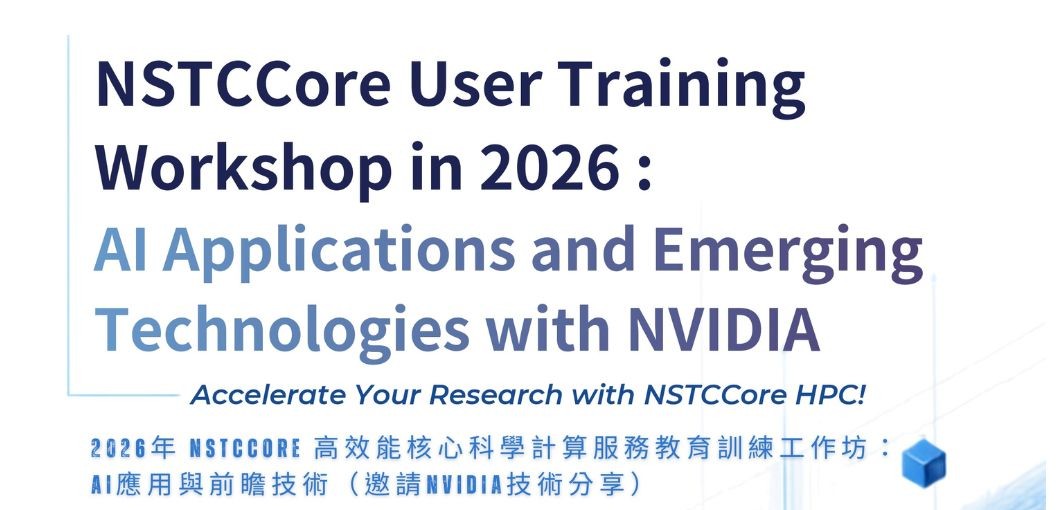
NSTCCore 高效能核心科學計算教育訓練工作坊:AI應用與前瞻技術(邀請NVIDIA技術分享)
2026 年 10 月 22 日(週四),將於中央研究院物理研究所舉辦「NSTCCore 高效能核心科學計算服務教育訓練工作坊,本次特別邀請 輝達(NVIDIA)技術講者,分享 AI、量子運算與高效能運算(HPC)的發展趨勢 ,並介紹 NSTCCore 核心計算服務資源與應用案例。
活動資訊 / 2026-09-23
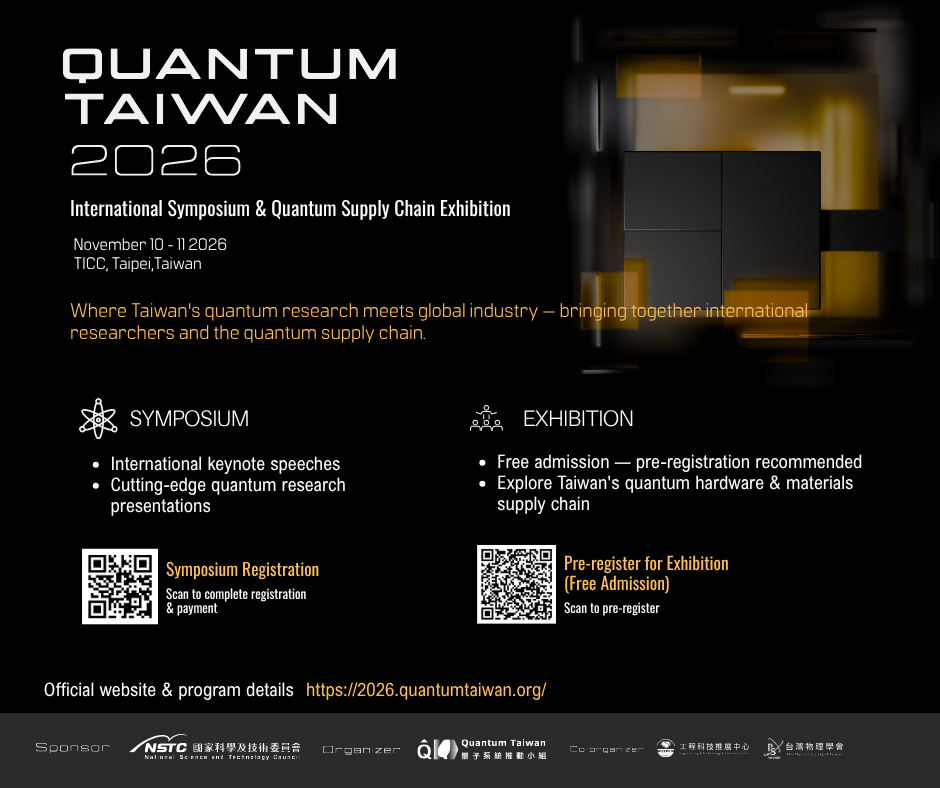
Quantum Taiwan 2026 正式開放報名。
活動將於 11 月 10 日至 11 日在台北國際會議中心(TICC)舉行, 同時涵蓋國際研討會與量子供應鏈展兩大部分。 國際研討會匯集國內外量子領域學者專題演講,發表前沿研究成果,採付費報名制,名額有限。
活動資訊 / 2026-09-15
【中研院物理所通識演講訊息】張泰榕特聘教授 (榮獲 2025 年國科會傑出研究獎)
【中研院物理所通識演講訊息】張泰榕特聘教授 (榮獲 2025 年國科會傑出研究獎)
中研院物理所特別邀請國立成功大學物理系張泰榕特聘教授(榮獲 2025 年國科會傑出研究獎)蒞臨演講。張教授專精於拓撲材料電子結構與第一性原理計算,本次演講將深入介紹拓撲能帶理論,並分享磁性與非磁性拓撲絕緣體及軌道拓撲(Orbital Topology)的最新前沿研究。誠摯邀請您一同參與! 【講座資訊】 講者:張泰榕 特聘教授(國立成功大學物理系) 演講題目:Electronic Structure of Topological Materials 時間:2026 年 9 月 8 日(二)14:00 地點:中央研究院物理研究所 1 樓演講廳 接待人:徐晨軒 助研究員 演講語言:英文 活動網頁:https://www.phys.sinica.edu.tw/lecture detail.php?id=3243&eng=T 【演講摘要】 Phase transitions are traditionally understood within Landau's framework of spontaneous symmetry breaking. The discovery of topological phases, however, has established a new paradigm in which quantum states are classified by the topology of their electronic wave functions. In this colloquium, I will introduce the basic concepts of topological band theory and discuss how first-principles calculations have guided the discovery of nonmagnetic and magnetic topological insulators. If time permits, I will conclude by presenting our recent work on orbital topology, highlighting a new topological perspective on the orbital Hall effect. 誠摯邀請您一同參與! 中央研究院物理研究所 敬邀 We are pleased to invite Prof. Tay-Rong Chang from National Cheng Kung University to speak at the upcoming IOP Colloquium. Prof. Chang specializes in the electronic structure of topological materials and first-principles calculations and is a recipient of the 2025 NSTC Outstanding Research Award. In this talk, he will introduce topological band theory and share recent research on topological insulators and orbital topology. 【Event Information】 Speaker: Prof. Tay-Rong Chang / Department of Physics, National Cheng Kung University Title: Electronic Structure of Topological Materials Date & Time: September 08, 2026 (Tue.) 14:00 Venue: 1F Auditorium, Institute of Physics, Academia Sinica Host: Dr. Chen-Hsuan Hsu Language: English Link: https://www.phys.sinica.edu.tw/lecture detail.php?id=3243&eng=T 【Abstract】 Phase transitions are traditionally understood within Landau's framework of spontaneous symmetry breaking. The discovery of topological phases, however, has established a new paradigm in which quantum states are classified by the topology of their electronic wave functions. In this colloquium, I will introduce the basic concepts of topological band theory and discuss how first-principles calculations have guided the discovery of nonmagnetic and magnetic topological insulators. If time permits, I will conclude by presenting our recent work on orbital topology, highlighting a new topological perspective on the orbital Hall effect. We warmly invite you to join us!
中研院物理所特別邀請國立成功大學物理系張泰榕特聘教授(榮獲 2025 年國科會傑出研究獎)蒞臨演講。張教授專精於拓撲材料電子結構與第一性原理計算,本次演講將深入介紹拓撲能帶理論,並分享磁性與非磁性拓撲絕緣體及軌道拓撲(Orbital Topology)的最新前沿研究。誠摯邀請您一同參與! 【講座資訊】 講者:張泰榕 特聘教授(國立成功大學物理系) 演講題目:Electronic Structure of Topological Materials 時間:2026 年 9 月 8 日(二)14:00 地點:中央研究院物理研究所 1 樓演講廳 接待人:徐晨軒 助研究員 演講語言:英文 活動網頁:https://www.phys.sinica.edu.tw/lecture detail.php?id=3243&eng=T 【演講摘要】 Phase transitions are traditionally understood within Landau's framework of spontaneous symmetry breaking. The discovery of topological phases, however, has established a new paradigm in which quantum states are classified by the topology of their electronic wave functions. In this colloquium, I will introduce the basic concepts of topological band theory and discuss how first-principles calculations have guided the discovery of nonmagnetic and magnetic topological insulators. If time permits, I will conclude by presenting our recent work on orbital topology, highlighting a new topological perspective on the orbital Hall effect. 誠摯邀請您一同參與! 中央研究院物理研究所 敬邀 We are pleased to invite Prof. Tay-Rong Chang from National Cheng Kung University to speak at the upcoming IOP Colloquium. Prof. Chang specializes in the electronic structure of topological materials and first-principles calculations and is a recipient of the 2025 NSTC Outstanding Research Award. In this talk, he will introduce topological band theory and share recent research on topological insulators and orbital topology. 【Event Information】 Speaker: Prof. Tay-Rong Chang / Department of Physics, National Cheng Kung University Title: Electronic Structure of Topological Materials Date & Time: September 08, 2026 (Tue.) 14:00 Venue: 1F Auditorium, Institute of Physics, Academia Sinica Host: Dr. Chen-Hsuan Hsu Language: English Link: https://www.phys.sinica.edu.tw/lecture detail.php?id=3243&eng=T 【Abstract】 Phase transitions are traditionally understood within Landau's framework of spontaneous symmetry breaking. The discovery of topological phases, however, has established a new paradigm in which quantum states are classified by the topology of their electronic wave functions. In this colloquium, I will introduce the basic concepts of topological band theory and discuss how first-principles calculations have guided the discovery of nonmagnetic and magnetic topological insulators. If time permits, I will conclude by presenting our recent work on orbital topology, highlighting a new topological perspective on the orbital Hall effect. We warmly invite you to join us!
活動資訊 / 2026-08-27
ALMA at 15 Years Science, Synergies, and the Road Ahead
ALMA 15週年國際盛會,2027相約台北!
Celebrating 15 Years of ALMA — See You in Taipei in 2027! 探索宇宙的腳步,下一站來到台灣! 國際研討會 「ALMA at 15 Years: Science, Synergies, and the Road Ahead」 將於 2027年2月22日至26日,在 中央研究院南港院區 盛大登場! 走過15年,ALMA(阿塔卡瑪大型毫米及次毫米波陣列)持續帶領我們看見前所未見的宇宙。這場國際盛會將集結全球天文學者,分享 ALMA 最新科學成果,交流跨設施合作的可能性,並共同探索 ALMA 下一階段的科學與未來。 摘要徵稿現正進行中! 摘要投稿截止:2026/9/15
Early-Bird 線上報名:2026/9/30 開放
Early-Bird 報名截止:2026/11/27
會議日期:2027/2/22–2/26
地點:中央研究院南港院區・台北 無論你的研究聚焦於恆星形成、行星系統、星際物質、星系演化,或運用 ALMA 與其他觀測設施進行天文研究,都歡迎投稿,與全球天文社群相聚台北! 更多會議資訊與投稿方式
https://2027alma.org/ 2027,我們台北見! Celebrating 15 Years of ALMA — See You in Taipei in 2027! The international conference “ALMA at 15 Years: Science, Synergies, and the Road Ahead” will take place February 22–26, 2027, at Academia Sinica in Taipei, Taiwan. For 15 years, the Atacama Large Millimeter/submillimeter Array (ALMA) has transformed our view of the Universe. This international conference will bring together astronomers from around the world to showcase the latest ALMA science, explore synergies with other major facilities, and look ahead to the next era of ALMA discoveries. Conference highlights include: Latest scientific results from ALMA Updates on the Wideband Sensitivity Upgrade (WSU) ALMA Archive and CARTA tutorials Scientific synergies between ALMA and other major facilities The future of ALMA science Abstract submission is now open! Abstract submission deadline: September 15, 2026
Early-Bird registration opens: September 30, 2026
Early-Bird registration deadline: November 27, 2026
Conference: February 22–26, 2027
Venue: Academia Sinica, Taipei, Taiwan Whether your research explores star formation, planetary systems, the interstellar medium, galaxy evolution, or science combining ALMA with other observing facilities, we invite you to submit an abstract and join the international astronomy community in Taipei! Learn more & submit your abstract
https://2027alma.org/ See you in Taipei in 2027!
Celebrating 15 Years of ALMA — See You in Taipei in 2027! 探索宇宙的腳步,下一站來到台灣! 國際研討會 「ALMA at 15 Years: Science, Synergies, and the Road Ahead」 將於 2027年2月22日至26日,在 中央研究院南港院區 盛大登場! 走過15年,ALMA(阿塔卡瑪大型毫米及次毫米波陣列)持續帶領我們看見前所未見的宇宙。這場國際盛會將集結全球天文學者,分享 ALMA 最新科學成果,交流跨設施合作的可能性,並共同探索 ALMA 下一階段的科學與未來。 摘要徵稿現正進行中! 摘要投稿截止:2026/9/15
Early-Bird 線上報名:2026/9/30 開放
Early-Bird 報名截止:2026/11/27
會議日期:2027/2/22–2/26
地點:中央研究院南港院區・台北 無論你的研究聚焦於恆星形成、行星系統、星際物質、星系演化,或運用 ALMA 與其他觀測設施進行天文研究,都歡迎投稿,與全球天文社群相聚台北! 更多會議資訊與投稿方式
https://2027alma.org/ 2027,我們台北見! Celebrating 15 Years of ALMA — See You in Taipei in 2027! The international conference “ALMA at 15 Years: Science, Synergies, and the Road Ahead” will take place February 22–26, 2027, at Academia Sinica in Taipei, Taiwan. For 15 years, the Atacama Large Millimeter/submillimeter Array (ALMA) has transformed our view of the Universe. This international conference will bring together astronomers from around the world to showcase the latest ALMA science, explore synergies with other major facilities, and look ahead to the next era of ALMA discoveries. Conference highlights include: Latest scientific results from ALMA Updates on the Wideband Sensitivity Upgrade (WSU) ALMA Archive and CARTA tutorials Scientific synergies between ALMA and other major facilities The future of ALMA science Abstract submission is now open! Abstract submission deadline: September 15, 2026
Early-Bird registration opens: September 30, 2026
Early-Bird registration deadline: November 27, 2026
Conference: February 22–26, 2027
Venue: Academia Sinica, Taipei, Taiwan Whether your research explores star formation, planetary systems, the interstellar medium, galaxy evolution, or science combining ALMA with other observing facilities, we invite you to submit an abstract and join the international astronomy community in Taipei! Learn more & submit your abstract
https://2027alma.org/ See you in Taipei in 2027!
活動資訊 / 2026-08-13

【8/7 中研院物理所學術演講_Prof. Jean-Marie TARASCON, Chair in “Chemistry of solids-Energy” (Collège de France)】
【時間】2026 年 8 月 7 日(星期五)14:00
【地點】中央研究院物理研究所1F演講廳
【演講者】Prof. Jean-Marie TARASCON (法國法蘭西公學院「固態化學與能源」講座 / Chair in "Chemistry of Solids-Energy", Collège de France))
【講題】Enhancing the energy density of Na-ion batteries: Critical challenges and prospective solutions
【摘要】
The ongoing shift towards clean energy requires a massive deployment of batteries for portable devices, electric mobility, and stationary energy storage systems. Lithium-ion batteries have become dominant in all of these applications due to their high energy density. However, the rapid growth in demand for lithium-ion batteries (LIBs) has put significant pressure on the lithium supply chain, hence the call for alternative/complementary energy storage devices. One such device is the sodium-ion battery (NIB. The significant knowledge gained from LiBs paved the way for the commercialisation of NiBs, with the first products based on TIAMAT’s NVPF/C technology appearing in power tools and data centres.
This battery has many advantages, and the key research steps leading to its development will be described. One of its strengths is its high performance, but one of its weaknesses is its low energy density compared to Li-ion technologies, such as LFP/C. To combat these limitations, our research has focused on developing new positive electrodes, such as Na-based NMC layered oxides and Prussian blue phases, as well as new negative electrodes, where hard carbon electrodes have been replaced with alloying (NaxSn) electrodes or even anode-free Na-ion systems. This presentation will emphasise the crucial role of the electrolyte in enhancing cell performance beyond what can be achieved through materials alone. It will conclude with an overview of new research trends in NIBs, together with a personal perspective on the NIB market share.
【主持人】吳茂昆院士 (中央研究院物理研究所)
【演講語言】英文
【活動網頁】https://www.phys.sinica.edu.tw/lecture detail.php?id=3235&eng=T
【地點】中央研究院物理研究所1F演講廳
【演講者】Prof. Jean-Marie TARASCON (法國法蘭西公學院「固態化學與能源」講座 / Chair in "Chemistry of Solids-Energy", Collège de France))
【講題】Enhancing the energy density of Na-ion batteries: Critical challenges and prospective solutions
【摘要】
The ongoing shift towards clean energy requires a massive deployment of batteries for portable devices, electric mobility, and stationary energy storage systems. Lithium-ion batteries have become dominant in all of these applications due to their high energy density. However, the rapid growth in demand for lithium-ion batteries (LIBs) has put significant pressure on the lithium supply chain, hence the call for alternative/complementary energy storage devices. One such device is the sodium-ion battery (NIB. The significant knowledge gained from LiBs paved the way for the commercialisation of NiBs, with the first products based on TIAMAT’s NVPF/C technology appearing in power tools and data centres.
This battery has many advantages, and the key research steps leading to its development will be described. One of its strengths is its high performance, but one of its weaknesses is its low energy density compared to Li-ion technologies, such as LFP/C. To combat these limitations, our research has focused on developing new positive electrodes, such as Na-based NMC layered oxides and Prussian blue phases, as well as new negative electrodes, where hard carbon electrodes have been replaced with alloying (NaxSn) electrodes or even anode-free Na-ion systems. This presentation will emphasise the crucial role of the electrolyte in enhancing cell performance beyond what can be achieved through materials alone. It will conclude with an overview of new research trends in NIBs, together with a personal perspective on the NIB market share.
【主持人】吳茂昆院士 (中央研究院物理研究所)
【演講語言】英文
【活動網頁】https://www.phys.sinica.edu.tw/lecture detail.php?id=3235&eng=T
活動資訊 / 2026-07-29

ALC 2026 最新消息! 摘要投稿延期至 7/31,Invited Speakers 陣容更新!
16th International Symposium on Atomic Level Characterizations for New Materials and Devices (ALC 2026) 摘要投稿截止日期已延長至 2026 年 7 月 31 日,邀請講員名單也同步更新,歡迎把握機會投稿,與來自世界各地的研究人員交流最新研究成果! ALC 是由日本真空與表面科學學會(JVSS)Microbeam Analysis Division 主辦的國際研討會,自 1997 年舉辦至今,聚焦於原子尺度材料與元件表徵、表面與界面科學、新材料探索及元件開發,是相關領域研究人員交流的重要國際平台。 Conference Dates: November 2–6, 2026 Venue: Howard Beach Resort, Kenting, Taiwan Plenary Speakers
• Prof. Dr. Ulrich Höfer (Universität Marburg / RUN)
• Prof. Wen-Hao Chang (National Yang Ming Chiao Tung University / Research Center for Applied Sciences)
• Prof. Dr. Ulrich Höfer (Universität Marburg / RUN)
• Prof. Wen-Hao Chang (National Yang Ming Chiao Tung University / Research Center for Applied Sciences)
活動資訊 / 2026-07-15

【2026 台灣矽光子技術論壇暨靜電防制專業工程師訓練】
【2026 台灣矽光子技術論壇暨靜電防制專業工程師訓練】 8 月 18 日 ~21 日 | 國立陽明交通大學 交映樓 國際會議廳 進入 AI 時代-你必須了解的矽光子最新發展趨勢、技術、與未來展望 隨著A I 時代資訊量呈現爆發式的成長,傳統電訊號銅線傳輸已逐漸逼近物理極限,而不敷使用。矽光子技術已成為突破資料傳輸瓶頸 的重要解決方案之一。光進銅退已成為 未來全世界A I 與半導體領域 高速資料傳輸的必然趨勢 。下一世代的高速資料傳輸已確定往共封裝光學(Co Packaged Optics CPO) 與光電積體電路 Photonic Integra ted Circuits , PIC) 光電共同封裝發展並能運用到高速光學 I /O 、 光學運算 、量子 科技 、前瞻感測等重要新興應用台灣政府已經把矽光子列為 「 AI 新十大建設」的核心項目 故矽光子 之重要 性 不言可喻 。台灣擁有全球領先的半導體製造、IC 設計、封裝測試及光電產業完整供應鏈,在矽光子發展上具備得天獨厚的優勢。從晶圓製程、異質整合、先進封裝,到高速光通訊模組與系統應用,皆已建立相當完整的技術基礎 矽光子產業在台灣政府的全力支持下正在高速系統性地發展 。 然而,矽光子涉及面向非常廣、涵蓋從材料、元件設計、製程、封 裝、量測、系統整合及應用等多個跨領域專業,需要產官學研各界共同合作,才能加速技術突破與產業落地 。 本論壇以「 驅動 A I 時代 之 前 瞻 矽光子技術 」為核心主題邀請 知名學者與業界專家共同分享矽光子最新技術發展趨勢與應用成果包含矽光子光電元件、C PO、光學計算、光學檢測、驗證流程及方法 、 與 矽光子光電積體電路設計布局與驗證希望藉由本論壇深入了解 矽光子的最新發展方向與未來挑戰,歡迎學界與業界先進一同前來交流與共襄 盛舉。 靜電防制專業工程師訓練對於許多人而言,靜電放電(Electrostatic Di scharge ESD) 只是天氣乾燥時觸摸金屬門把、或穿脫毛衣時感 受到的電擊現象;然而,隨著科技日新月異以及生產製程演進突破,電子元件對於靜電放電的敏感程度亦隨之急速上升,如果輕忽靜電放電的危害,極有可能導致大量產品故障損壞,並使企業蒙受難以估計的損失。 有鑑於此,台灣靜電放電防護工程學會與ESD 產學聯盟特地邀集相關領域之專業講師,即將於新竹舉辦訓練課程,藉由提供靜電防護專業知識技術與執行方法,期望能有效推廣正確的靜電防護觀念,並協助產業強化與落實國際競爭力。 *本課程適用學習對象: 電子產業 半導體、光電、電子零組件、生產 設備以及電腦周邊等 從業人員、廠區製程 ESD 防護執行及 其測量稽核人員、供應商品質工程師 晶片設計、生產與測試委外等公司 、技術研發人員、業務推廣人員或企業中高階主管。 * 講師一覽 第一天講師 國立 陽明交 通大學 張國恩教授 、 之光半導體 陳昇祐博士 第二天講師 之光半導體 吳以珩 工程師 第三天講師 道益有限公司 蔡東振經理 第四天講師 道益有限公司 蔡東振經理 * 活動地點 新竹市大學路1001 號 國立陽明交通大學光復校區 交映樓 1F 國際會議廳 * 報名費用(含 當日 講義) 1. T ESDA 會員: 單日 活動 每人 NT$3,500 ;報名兩日(含)以上 活動 享 9 折優惠 。 2. 非會員: 單日 活動 每人 NT$ 4 0 00 ;報名兩日(含)以上 活動 享 9 折優惠 。 3. 學 生 單日 活動 每人 NT$ 2 ,500 ;報名兩日(含)以上 活動 享 9 折優惠 。 * 線上報名網站:https://docs.google.com/....../1FAIpQLScKidV8....../viewform * 報名注意事項 1. 報名期限:至活 動前一週為止 名 額有限,敬請把握機 會以免向隅。 2. 學生報名時請附 學生證影印本 。 3. 填妥報名表後, 請於報名期限內完成繳費 。 4. 已報名者請於當天自行前往會場報到,收據、講義於報到時領取。 5. 主辦單位保留變更講師、調整活動議程及取消本活動之權利。如活動內容有所異動,將另行公告或通知;若因活動取消而已完成繳費,主辦單位將辦理全額退費。 6.「 第三天 靜電防 制專業工程師訓練 」注意事項 全程參與且參加測驗者,由學會頒發結業證書 ;通過測 驗者,本學會另頒發「 靜電防制專業工程師」證書,證書將在課程結束 1~2 個月內寄發 。以學生身份報名者恕不頒發任何證書。 * 繳費方式 請於下列 兩 種方式中擇一完成 1. ATM 轉帳: 請 轉帳至郵局帳 戶, 郵局 代號 700 、 局號 0061251 、 帳 號 0124704 、 戶名 『台灣靜電放電防護工程學會 林群祐 』 (轉帳 所需 之銀行手續費由報名者 自行負擔),並將轉帳收據註明姓名,將檔案以 e mail 寄到 taiwanesda@gmail.com 劉小姐收。 2. 信用卡繳費: 請連結至 歐付寶 付款系統 線上刷卡 須加入歐付寶會員 http s ala b.iee.nycu.edu.tw/~es d/TESDW/pay.html *主辦單位 台灣靜電放電防護工程學會 (Taiwan ESD Asso ciation, T ESDA) http s :/://t es da.org/ * 協辦單位 國立陽明交通大學半導體工程學系 https://mee.nycu.edu.tw/ * 聯絡方式 1. 劉 小姐 03 6681457 taiwanesda@gmail.com 302 新竹縣竹北巿高鐵一 路 36 號 3 樓 2. 卓 小 姐 03 5131370 jeancho @nycu.e du.tw 300 新竹市大學路 1001 號 交映樓 601 室
活動資訊 / 2026-07-15

「高壓科學工作坊 International Workshop on High Pressure Science, IWHPS 2026」
高壓科學工作坊 IWHPS 2026|熱烈報名中! 壓力是探索新穎材料、極端環境與物質相變的重要物理參數。2026 年高壓合成與量測技術秋季學校將於國立臺灣大學舉辦「高壓科學工作坊(International Workshop on High Pressure Science, IWHPS 2026)」,聚焦高壓技術、先進量測與結構解析,邀請國內外專家分享最新研究進展與實作經驗。 三大主題場次 Large-Volume Press (LVP)
大壓力機與高壓高溫合成技術,新穎亞穩態材料製備與大型設施高壓量測應用。 Diamond Anvil Cell (DAC)
鑽石高壓砧技術,涵蓋高壓下的光學、電性、磁性、拉曼光譜與 X 光繞射量測。 Single-Crystal X-ray Diffraction (SC-XRD)
單晶 X 光繞射與高壓技術結合,聚焦微晶量測、結構解析與壓力誘發相變研究。 活動亮點 本工作坊結合專題演講、技術課程與實作訓練,帶領學員踏入高壓研究領域,深入了解高壓科學的理論與實務應用。 適合對象 • 大學部與研究所學生
• 博士後研究員
• 對高壓科學、材料合成、結構解析與極端條件量測有興趣之研究人員 活動資訊 活動日期|2026 年 8 月 31 日至 9 月 2 日
活動地點|國立臺灣大學 凝態科學研究中心
預計名額|約 70 人
活動網站|https://www.ntu-ccms.ntu.edu.tw/lab/press/IWHPS/zh/
報名連結|https://forms.gle/bh5wJzB6KY5NizWm7
報名截止|2026 年 7 月 31 日 注意事項 本活動名額有限,主辦單位將依研究背景、參與動機、課程與實作需求進行審核,並以 Email 通知錄取結果。
大壓力機與高壓高溫合成技術,新穎亞穩態材料製備與大型設施高壓量測應用。 Diamond Anvil Cell (DAC)
鑽石高壓砧技術,涵蓋高壓下的光學、電性、磁性、拉曼光譜與 X 光繞射量測。 Single-Crystal X-ray Diffraction (SC-XRD)
單晶 X 光繞射與高壓技術結合,聚焦微晶量測、結構解析與壓力誘發相變研究。 活動亮點 本工作坊結合專題演講、技術課程與實作訓練,帶領學員踏入高壓研究領域,深入了解高壓科學的理論與實務應用。 適合對象 • 大學部與研究所學生
• 博士後研究員
• 對高壓科學、材料合成、結構解析與極端條件量測有興趣之研究人員 活動資訊 活動日期|2026 年 8 月 31 日至 9 月 2 日
活動地點|國立臺灣大學 凝態科學研究中心
預計名額|約 70 人
活動網站|https://www.ntu-ccms.ntu.edu.tw/lab/press/IWHPS/zh/
報名連結|https://forms.gle/bh5wJzB6KY5NizWm7
報名截止|2026 年 7 月 31 日 注意事項 本活動名額有限,主辦單位將依研究背景、參與動機、課程與實作需求進行審核,並以 Email 通知錄取結果。
活動資訊 / 2026-07-13